

LYT YOGA PDF Guides:
FREE Spine Mobility Standing Exercises
- Upright Mobility: Train spinal range of motion in the positions you use all day
- Posture Reset: Restore the natural curves of the spine against gravity
- Expert Guidance: Created by Lara Heimann, PT and LYT Founder
- Anywhere Practice: No floor, no mat — just your body and a wall for one exercise
Program Overview:
15+
Exercises
10-15
min/ day
0 Machine
Needed
Perfect For:
Anyone who feels stiff, compressed, or restricted during daily activity — desk workers, drivers, parents, athletes — plus those with postural pain, limited spinal rotation, or anyone who wants a quick daily practice to keep the spine moving freely throughout the day.
PT-Designed
Evidence-based movements
Functional Focus
Real-world daily applications
Brain Mapping
Retrain movement patterns
Immediate Results
Feeling better from day one
Why Standing Spine Mobility Changes How You Move All Day
Floor exercises free the spine from load — standing exercises teach it to move while supporting you. The LYT standing spine mobility sequence uses gravity as both a challenge and an ally, training the thoracic, lumbar, and cervical spine to remain mobile in the exact conditions of your daily life.
- Triple S at Wall: Instantly recalibrate spinal alignment and identify restriction using the LYT signature assessment
- Thoracic Rotation: Goal Post Twists and Thoracic Peel Backs restore the rotational range most lost to sitting
- Lateral Freedom: Goddess Side Bends open the lateral spinal muscles that shorten with habitual one-sided postures
- Lumbopelvic Rhythm: Goddess Pelvic Circles and Rib Shifts retrain the coordinated relationship between the pelvis and spine
- Cervical Integration: Upper Back Flexion/Extension trains the thoracic spine to support and free the cervical vertebrae above it


The Posture Crisis — and How Standing Mobility Solves It
Modern posture problems are not about weakness — they are about lost range of motion. When the thoracic spine stiffens into a forward-flexed position, no amount of strength training will restore upright posture. Only restoring thoracic extension and rotation mobility can address the root cause.
- Reverse Desk Posture: Thoracic extension and rotation mobility directly counteracts the forward-flexed spine from sitting
- Reduce Neck Pain: A mobile thoracic spine reduces the compensatory load placed on the cervical vertebrae
- Improve Breathing: Thoracic mobility allows the ribcage to expand fully — increasing lung capacity and reducing respiratory fatigue
- Enhance Athletic Rotation: Spinal rotation drives performance in golf, tennis, swimming, running, and virtually every sport
- Stand Taller Immediately: Restoring thoracic extension creates visible postural improvement within a single session
Reclaim Your Upright Range of Motionwith LYT Yoga Method
Thoracic Freedom
Unlock the most restricted region of the modern spine. Goal Post Twists and Thoracic Peel Backs restore the rotational range that desk work, driving, and screen time progressively steal from the thoracic vertebrae.
Lumbopelvic Rhythm
Retrain the spine and pelvis to move as fluid partners. Goddess Pelvic Circles and Rib Shifts restore the coordinated wave of movement between the lumbar spine and pelvis that gives every step its natural rhythm.
Lateral Release
Free the side-body from chronic compression. Goddess Side Bends restore lateral spinal mobility — the direction most neglected in conventional stretching — reducing the rib and flank tightness that limits breathing and posture.
Postural Reset
Realign in minutes. The Triple S at Wall exercise uses the LYT signature spinal assessment to immediately identify and address your personal restriction pattern — providing a fast, precise recalibration you can do anywhere.
Explore More classes and programs
Spine mobility is just the beginning. Discover specialized programs for core strength, hip health, shoulder stability, and total-body functional movement.
Online classes
Teacher training
Corporate
Individual and Group Private sessions
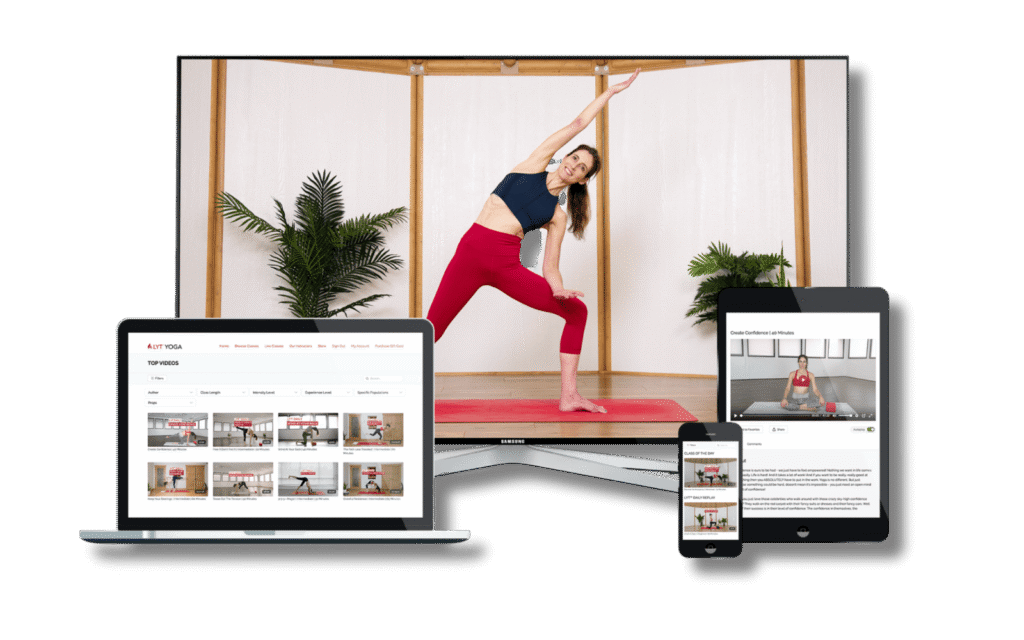
Your Movement Practice, On Demand
Busy schedule? No problem. Access LYT Daily classes anytime, anywhere with our mobile app for Android and iOS. Movement that fits your life.




Start Moving Better Today
Your spine loses a little freedom every day you don’t move it intentionally. Download this free guide and reclaim the upright range of motion that makes you stand taller, breathe deeper, and move through life without the stiffness that creeps in when the spine goes unmoved.

What LYT Students Are Saying
LYT Yoga literally changed my life: my posture, my strength, my balance and my spirit. From rounded shoulders, forward tilted pelvis and text neck to more upright, elongated and powerful way of standing and moving. The relentless discipline in sequencing the class into reset to activate the deep core muscles and then practice of asanas aimed to strengthen, stabilize and improve movement patterns makes wonders. It was a transformational experience for me which made me feel stronger, braver, better and more kind.

Magdalena
Practicing LYT has changed my mind set, my body & my overall well being. My body is so much stronger, I feel more centred & in control of my life & feel I have more of a purpose. You don’t need to be a yogi to practice here. Whatever sport you are doing/playing – practicing on LYT daily will enhance your performance but also give you the ability to do the things you love.
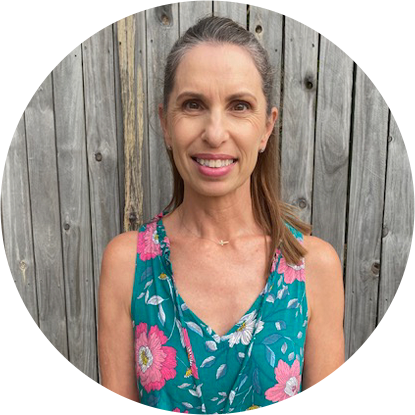
Julie Miller
I used to have imbalances in my body, and it wasn’t until I began to practice yoga on the LYT Daily that I began to heal. I credit the LYT Method’s focus on posture, core integration, and optimal movement in healing my frozen shoulder a couple years ago faster than any other method I had tried. If you are at the beginning or at the end of your healing journey, or if your new or a veteran of yoga, you will find so much content to love & incorporate into your daily movement!

Marci McMahon
Life changing. I met Lara in 2016 and after 5 years as a fitness professional (personal trainer, FMS 1,2, TRX, Kettlebells), I felt like I had met the Ghandi of Movement. I have watched LYT literally transform the world of yoga and movement. I am deeply honored to continue my practice and training with LYT and this knowledge and experience is transformative, energizing, and humbling. LYT changed me inside and out. The connections, community, and CORE values are priceless.
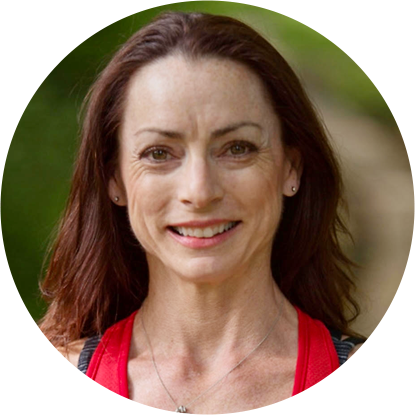
Kristi Rosenberg (Herbert)
Before I found Lara and her brilliant LYT method I was told that I should not practice yoga anymore (after 20 years) because my spine was “such a mess.” I am not only practicing LYT yoga daily, I am also a LYT certified teacher — one of the great joys of my life. LYT helps me keep my core stronger than strong and my spine aligned. I feel so much better because I know how to practice and move in fun, functional and optimal ways. Anything is possible, even doing handstands when you’ve made over 60 trips around the sun!
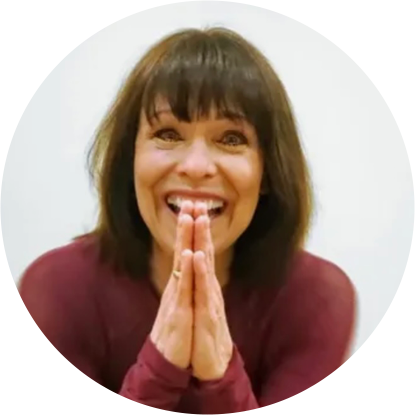
Julie Glick
Unable to simply get out the car without pain, I was educated by Lara and realised that I could move asymmetrically and not have pain. Even better, that I could do fun movements, challenging ones and big ones! I wasn’t going to end up in a yoga practice which was just restorative yoga. Classical yoga kept me small at this time as I couldn’t do it without pain but with LYT I felt expressive, passionate, energetic and joyful. It gave me a whole new lease on life.

Jane Langan
LYT offers so much variety which is wonderful, and it’s so empowering to get to know your body better how it moves and how it works. I was able to find classes that were perfect to support me through the loss of my mum. I love practicing at home but knowing there is a community of people right behind the screen who I can reach out to. It’s perfect and it just keeps getting better and better.
Nyree Petitjean
Learning smart LYT Yoga has helped me become aware of my daily movement habits (good and bad) both on and off the mat. It has taught me how to move in a more optimal manner. Becoming aware is the first step in making positive changes. I love LYT so much that I became LYT certified and I will continue to learn as much as I can through the ongoing certification programs.

Sharon Henderson
I went through a lot of years of formal medical education, but I have never understood and appreciated the power and resilient capacity of the human body more than I do now as a result of my LYT yoga practice. Every class not only offers safe and joyful movement, but also education that is practical and applicable. I feel secure and continue to grow knowing I can access class anytime time or place, but also the platform is always there no matter where I am physically and emotionally in my life.

Leigh Campbell
Since shifting from a traditional style of yoga practice to LYT Yoga, I have learnt so much more about my body and its function which is so important in a movement practice. The experience is whole, I get to move my body, strengthen and nourish it helping me feel great not only physically but it also brings me so much joy during class that I feel renewed each time. It´s something I look forward to doing everyday like a slice of paradise within my day. And that allows me to be there for those who need me the most.

Stacey Memije
Frequently Questions Answered
Why does thoracic spine mobility matter more than any other spinal region?
The thoracic spine — the 12 vertebrae of the mid-back — is the most commonly restricted region of the spine in modern adults, and its restriction has the most far-reaching consequences. The thoracic spine is anatomically designed for rotation and extension, but prolonged sitting causes it to stiffen into a flexed, compressed position. When this happens, the cervical spine (neck) and lumbar spine (lower back) are forced to compensate by taking on movement demands they were not designed for — leading to neck pain, lower back pain, and shoulder dysfunction simultaneously. Restoring thoracic mobility therefore addresses the root cause of pain in multiple body regions at once. The LYT standing spine mobility sequence prioritizes thoracic freedom through Goal Post Twists, Thoracic Peel Backs, and Upper Back Flexion/Extension — three exercises that directly restore the rotational and extensional range most lost to modern posture habits.
What makes the Triple S at Wall different from other posture exercises?
The Triple S at Wall is unique because it functions simultaneously as an assessment tool and a therapeutic exercise. By standing 4 to 6 inches from a wall and attempting to line up the skull, shoulder blades, and sacrum simultaneously against the wall surface, you immediately identify which spinal regions cannot achieve their natural curve. Most people find that either their head projects forward away from the wall (indicating cervical and thoracic restriction) or their lower back arches excessively away from the wall (indicating lumbar hypermobility compensating for thoracic stiffness). Simply maintaining the Triple S position with all three contact points against the wall for 10 seconds begins the neurological recalibration of spinal alignment. Unlike generic posture cues like ‘stand up straight,’ the Triple S gives the nervous system a precise, tactile reference for what aligned posture actually feels like — making the improvement automatic over time.
How do Goddess Rib Shifts improve spinal mobility and posture?
Goddess Rib Shifts target one of the most underappreciated components of spinal mobility — the ability to move the rib cage independently of the pelvis in the lateral plane. In the Goddess position (wide stance with toes turned out), you shift the rib cage to the left without allowing the lower half of the body to move, then shift it to the right. This exercise trains the deep thoracic and intercostal muscles to control lateral rib position, which is essential for both spinal mobility and breathing mechanics. Most people discover in this exercise that their rib cage and pelvis have become rigidly coupled — they move together as a single unit rather than as independent segments. The rib cage’s ability to shift independently of the pelvis is critical for the natural spinal rotation that occurs during walking, and its restriction is a common contributor to gait inefficiency and thoracolumbar stress.
Can standing spine mobility exercises help with sciatica?
Sciatica — pain radiating from the lower back down the leg along the sciatic nerve — has several possible causes, and whether standing spine mobility exercises are appropriate depends on the specific mechanism. When sciatica is related to lumbar stiffness and reduced spinal mobility causing nerve tension, exercises that restore lumbar and thoracic range of motion can be genuinely therapeutic. The Goddess Pelvic Circles and Goal Post Twists in this guide specifically restore lumbopelvic rhythm and thoracolumbar rotation, which can reduce the mechanical stress on lumbar nerve roots. However, when sciatica is caused by acute disc herniation or spinal stenosis, some movements may aggravate the condition. Anyone experiencing sciatica symptoms should consult their physician or physical therapist before beginning this program. That said, many people with mild to moderate sciatic symptoms find significant relief from regular spinal mobility practice.
How do Goal Post Twists differ from standard spinal twists or yoga twists?
Goal Post Twists are distinguished by two key elements that most standard spinal twists lack: a staggered stance and a deliberate pelvic anchor. By staggering one foot in front with a neutral pelvis and bringing the arms into goal post position, the exercise creates a fixed pelvis from which the thoracic spine can rotate independently. Most yoga twists allow the pelvis to rotate along with the thoracic spine, which reduces the mechanical demand on the mid-back and allows the lumbar spine to take over the movement. The staggered stance in Goal Post Twists prevents this by anchoring the pelvis — ensuring that the rotation occurs in the thoracic vertebrae where it is most needed. Twisting towards the front leg specifically targets the thoracic paraspinal muscles and intercostals on that side, creating a deeper and more functionally specific rotational stimulus than twists performed with a symmetrical stance.
How quickly can I expect to see posture improvements from standing spine mobility exercises?
Visible postural improvements can occur within a single session of standing spine mobility work — particularly from the Triple S at Wall exercise, which immediately recalibrates the nervous system’s reference for aligned posture. This initial improvement is neurological rather than structural, reflecting a change in muscle tone and postural habit rather than tissue remodeling. Lasting structural changes — including measurable improvements in thoracic kyphosis angle, neck position, and lumbar curve — typically become established within four to six weeks of daily practice. The key variable is consistency: daily practice produces exponentially faster results than occasional sessions because posture is fundamentally a habit of the nervous system, and habits change through repetition. Most people who practice the seven exercises in this guide daily report that colleagues, family members, or their mirror begin to reflect visible improvement within three to four weeks.
What is the difference between spine mobility and spine flexibility, and which matters more?
The distinction mirrors the hip mobility versus flexibility discussion — and the answer is the same. Spinal flexibility refers to passive range of motion: how far the spine can be moved when external force is applied, such as gravity pulling you into a forward fold. Spinal mobility refers to active range of motion: how much range the nervous system can access and control under its own muscular effort during real-life movements like reaching, rotating, and bending. You can be passively flexible in the spine while having poor active spinal mobility — meaning that large range is unavailable to you in functional movement because your nervous system cannot actively control it. The LYT standing spine mobility exercises specifically train active mobility — each exercise requires muscular engagement and neural control throughout the movement range. This is why LYT practitioners experience their mobility improvements as feeling freer and more capable in daily life, rather than simply being able to reach further in static stretches.
LYT YOGA Instructors
Our instructors are more than just experts of movement, they understand the body’s mechanics and guide you every step of the way to achieve your goals.
- Instructor
Lara Heimann
Lara Heimann
- Instructor
Kristin Williams
Kristin Williams
- Instructor
Rhonna Griffin
Rhonna Griffin
- Instructor
Teagan Schweitzer
Teagan Schweitzer
- Instructor
Brenda Lawer
Brenda Lawer
- Instructor
Poppy Zahn
Poppy Zahn
- Instructor
Sharon Tyrrell
Sharon Tyrrell
- Instructor
Jessica Hensley
Jessica Hensley
- Instructor
Katrina Latimer
Katrina Latimer
- Instructor
Jeremy Engel
Jeremy Engel
- Instructor
Shefali Shah
Shefali Shah
- Instructor
Campbell Will
Campbell Will
- Instructor
Maria Webb
Maria Webb
- Instructor
Megan Spears
Megan Spears
- Instructor
Paola Ricardo
Paola Ricardo
- Instructor
Ashley Newton
Ashley Newton
- Instructor
Michelle Onion
Michelle Onion
Download Your FREE Spine Mobility Standing Guide
Join thousands who’ve transformed their movement with the LYT Yoga Method. Get instant access to your complete spine mobility standing exercise guide — PT-designed to restore upright spinal freedom and end the stiffness that limits how you move, breathe, and feel every day.
What You'll Get:
- 7 standing spine mobility exercises targeting every spinal region from neck to pelvis
- Professional photographs demonstrating precise alignment and movement cues for each exercise
- The LYT Triple S assessment method for identifying and addressing your personal spinal restriction
- Anatomical explanations linking each exercise to its postural and pain-relief benefits
- PT-designed sequencing for comprehensive upright spinal mobility in under 15 minutes
- Guidance on integrating this practice into daily life — at your desk, before workouts, or as a morning reset
Get Instant Access
- Delivered Straight to Your Inbox
- Your data is 100% Private
- Join 50,000+ LYT Practitioners
