

LYT YOGA PDF Guides:
FREE Spine Mobility Floor Exercises
- Full Spinal Range: Address the cervical, thoracic, and lumbar spine in one sequence
- Pain Relief: Reduce stiffness and discomfort through safe, guided spinal movement
- Expert Guidance: Created by Lara Heimann, PT and LYT Founder
- Floor-Based: Gentle, accessible exercises for all levels — no equipment required
Program Overview:
15+
Exercises
10-15
min/ day
0 Machine
Needed
Perfect For:
Anyone suffering from morning back stiffness, limited spinal rotation, chronic tension from desk work or driving, those recovering from mild back discomfort, or anyone wanting to restore the full natural range of motion their spine was designed to have.
PT-Designed
Evidence-based movements
Functional Focus
Real-world daily applications
Brain Mapping
Retrain movement patterns
Immediate Results
Feeling better from day one
Restore Every Region of Your Spine on the Floor
The floor is the ideal environment for spinal mobility work — the spine is decompressed, gravity assists the release, and precise vertebral movement becomes possible. The LYT Method sequences these exercises to address the entire spine from the cervical vertebrae down to the sacrum.
- Cervical Mobility: Restore natural neck rotation and side bending lost to screen time and stress
- Thoracic Release: Unlock the mid-back — the most commonly restricted region of the spine
- Lumbar Articulation: Retrain the lower back to move through its full range with Pelvic Tilts and Caterpillar Rolls
- Rotational Freedom: Thoracolumbar Rotation targets the junction where most spinal dysfunction originates
- Segmental Control: The Caterpillar Roll teaches individual vertebral articulation — a skill most adults have lost


Why Spinal Mobility Affects Your Entire Body
A mobile spine is not a luxury — it is the structural prerequisite for pain-free movement throughout your whole body. When the spine loses range of motion, every system above and below it is forced to compensate.
- Reduce Back Pain: Restored spinal mobility removes the mechanical stress that causes chronic back tension
- Improve Posture: Mobile thoracic vertebrae allow the ribcage to expand and the shoulders to settle into alignment
- Enhance Breathing: Thoracic mobility directly impacts lung capacity and diaphragm function
- Protect the Neck: A mobile thoracic spine reduces the compensatory load placed on cervical vertebrae
- Age with Freedom: Spinal mobility is one of the strongest predictors of functional independence as we age
Move Your Spine the Way It Was Designed with LYT Yoga Method
Segmental Control
Rediscover individual vertebral movement. The Caterpillar Roll and Pelvic Tilts retrain your spine to articulate one segment at a time — restoring the control most adults have lost to habitual stiffness.
Rotational Depth
Reclaim thoracolumbar rotation. Exercises like Thoracolumbar Rotation and Goal Post Twists restore the twisting range critical for walking, reaching, and athletic movement.
Cervical Freedom
Release neck tension at the source. Cervical Rotation and Cervical Side Bending restore the full rotational and lateral range that screen time, stress, and poor posture progressively restrict.
Whole-Spine Integration
Connect every region of the spine. The LYT sequencing ensures cervical, thoracic, and lumbar mobility work together — creating fluid, coordinated spinal movement rather than isolated segments.
Explore More classes and programs
Spine mobility is just the beginning. Discover specialized programs for core strength, hip health, shoulder stability, and total-body functional movement.
Online classes
Teacher training
Corporate
Individual and Group Private sessions
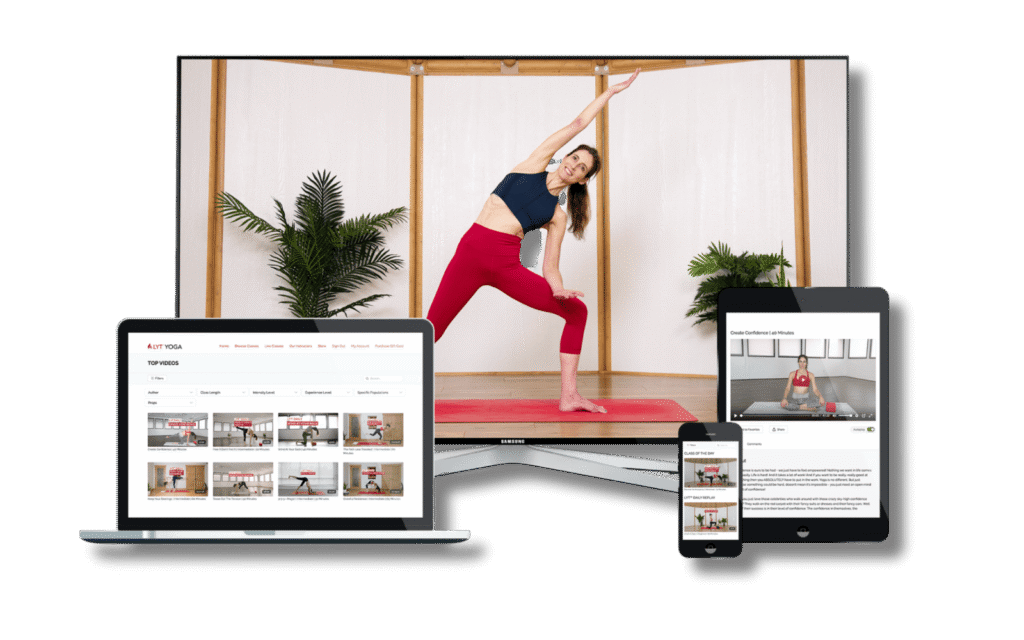
Your Movement Practice, On Demand
Busy schedule? No problem. Access LYT Daily classes anytime, anywhere with our mobile app for Android and iOS. Movement that fits your life.




Start Moving Better Today
Don’t spend another morning waiting for your back to loosen up. Download this free guide and give your spine the movement it’s been craving — seven targeted floor exercises that take less than 15 minutes and address every region from your neck to your sacrum.

What LYT Students Are Saying
LYT Yoga literally changed my life: my posture, my strength, my balance and my spirit. From rounded shoulders, forward tilted pelvis and text neck to more upright, elongated and powerful way of standing and moving. The relentless discipline in sequencing the class into reset to activate the deep core muscles and then practice of asanas aimed to strengthen, stabilize and improve movement patterns makes wonders. It was a transformational experience for me which made me feel stronger, braver, better and more kind.

Magdalena
Practicing LYT has changed my mind set, my body & my overall well being. My body is so much stronger, I feel more centred & in control of my life & feel I have more of a purpose. You don’t need to be a yogi to practice here. Whatever sport you are doing/playing – practicing on LYT daily will enhance your performance but also give you the ability to do the things you love.
Julie Miller
I used to have imbalances in my body, and it wasn’t until I began to practice yoga on the LYT Daily that I began to heal. I credit the LYT Method’s focus on posture, core integration, and optimal movement in healing my frozen shoulder a couple years ago faster than any other method I had tried. If you are at the beginning or at the end of your healing journey, or if your new or a veteran of yoga, you will find so much content to love & incorporate into your daily movement!

Marci McMahon
Life changing. I met Lara in 2016 and after 5 years as a fitness professional (personal trainer, FMS 1,2, TRX, Kettlebells), I felt like I had met the Ghandi of Movement. I have watched LYT literally transform the world of yoga and movement. I am deeply honored to continue my practice and training with LYT and this knowledge and experience is transformative, energizing, and humbling. LYT changed me inside and out. The connections, community, and CORE values are priceless.
Kristi Rosenberg (Herbert)
Before I found Lara and her brilliant LYT method I was told that I should not practice yoga anymore (after 20 years) because my spine was “such a mess.” I am not only practicing LYT yoga daily, I am also a LYT certified teacher — one of the great joys of my life. LYT helps me keep my core stronger than strong and my spine aligned. I feel so much better because I know how to practice and move in fun, functional and optimal ways. Anything is possible, even doing handstands when you’ve made over 60 trips around the sun!
Julie Glick
Unable to simply get out the car without pain, I was educated by Lara and realised that I could move asymmetrically and not have pain. Even better, that I could do fun movements, challenging ones and big ones! I wasn’t going to end up in a yoga practice which was just restorative yoga. Classical yoga kept me small at this time as I couldn’t do it without pain but with LYT I felt expressive, passionate, energetic and joyful. It gave me a whole new lease on life.

Jane Langan
LYT offers so much variety which is wonderful, and it’s so empowering to get to know your body better how it moves and how it works. I was able to find classes that were perfect to support me through the loss of my mum. I love practicing at home but knowing there is a community of people right behind the screen who I can reach out to. It’s perfect and it just keeps getting better and better.
Nyree Petitjean
Learning smart LYT Yoga has helped me become aware of my daily movement habits (good and bad) both on and off the mat. It has taught me how to move in a more optimal manner. Becoming aware is the first step in making positive changes. I love LYT so much that I became LYT certified and I will continue to learn as much as I can through the ongoing certification programs.

Sharon Henderson
I went through a lot of years of formal medical education, but I have never understood and appreciated the power and resilient capacity of the human body more than I do now as a result of my LYT yoga practice. Every class not only offers safe and joyful movement, but also education that is practical and applicable. I feel secure and continue to grow knowing I can access class anytime time or place, but also the platform is always there no matter where I am physically and emotionally in my life.

Leigh Campbell
Since shifting from a traditional style of yoga practice to LYT Yoga, I have learnt so much more about my body and its function which is so important in a movement practice. The experience is whole, I get to move my body, strengthen and nourish it helping me feel great not only physically but it also brings me so much joy during class that I feel renewed each time. It´s something I look forward to doing everyday like a slice of paradise within my day. And that allows me to be there for those who need me the most.

Stacey Memije
Frequently Questions Answered
Why does my spine feel so stiff, especially in the morning?
Morning spinal stiffness is caused by a combination of factors. During sleep, intervertebral discs rehydrate by absorbing fluid from surrounding tissues — this makes them slightly thicker and the spine temporarily less mobile. Additionally, prolonged inactivity allows the muscles and connective tissue surrounding the spine to cool and stiffen. For people who spend significant time sitting during the day, the spine adapts to this compressed, flexed position over time, making it progressively harder to access full range of motion. The LYT floor mobility exercises specifically address this by gently restoring fluid movement through all spinal regions — the Triple S position alone begins the process of rehydrating and decompressing the discs. Regular morning practice of 10 to 15 minutes can dramatically reduce the duration and severity of morning stiffness within two to three weeks.
What is the Triple S position and why does LYT Yoga use it as a foundation?
The Triple S refers to the three natural spinal curves — the cervical lordosis (neck), thoracic kyphosis (mid-back), and lumbar lordosis (lower back) — all making simultaneous contact with the floor: skull, shoulder blades, and sacrum. This position is used as a diagnostic and therapeutic tool in the LYT Method because it immediately reveals where the spine has lost its natural curves. When you lie supine and cannot make all three contact points with the floor simultaneously, it indicates restriction in that spinal region. The Triple S on Floor exercise uses this position as a starting point — lying with feet flat, allowing the spine to find its natural relationship with gravity. Holding this for 10 seconds begins the neurological process of resetting spinal tone and teaching the brain what a balanced, decompressed spine feels like. It is the foundation from which all other mobility work builds.
How does the Caterpillar Roll exercise improve spinal mobility?
The Caterpillar Roll is one of the most therapeutically valuable exercises in the LYT spine mobility repertoire because it demands individual vertebral articulation — the ability to sequentially peel each vertebra away from and back onto the floor one at a time. Most adults move their lumbar spine as a single rigid unit, having lost the segmental control that should allow each vertebra to move independently. This rigidity is a primary contributor to lower back pain, as it concentrates mechanical stress on specific spinal segments rather than distributing it evenly. The Caterpillar Roll retrains this segmental control by requiring a slow, deliberate articulation: lifting into a low bridge one vertebra at a time, then lowering one vertebra at a time. Over weeks of practice, this exercise restores the spine’s natural wave-like mobility and significantly reduces the mechanical loading that causes chronic lower back discomfort.
Can floor spine mobility exercises help with disc problems or herniated discs?
Many of the floor spine mobility exercises in this guide are appropriate and beneficial for people with disc-related issues, but the appropriateness of specific movements depends on the nature and severity of the condition. Exercises like Pelvic Tilts, Cervical Rotation, and Thoracolumbar Rotation are generally well-tolerated and often prescribed by physical therapists for disc conditions because they restore spinal mobility without compressive loading. Exercises involving spinal flexion — like certain phases of the Caterpillar Roll — may need to be modified or avoided during acute disc flares. The LYT Method’s foundation in physical therapy means every exercise is designed with joint safety in mind. However, anyone with a diagnosed disc condition, recent spinal injury, or acute back pain should consult their physician or physical therapist before beginning this or any exercise program.
What is thoracolumbar rotation and why is it so important for back health?
The thoracolumbar junction refers to the region where the thoracic spine (mid-back) meets the lumbar spine (lower back) — roughly at the level of the bottom ribs. This junction is biomechanically significant because the thoracic spine is designed for rotation while the lumbar spine is designed primarily for flexion and extension with minimal rotation. When thoracic rotation is restricted — which is extremely common in people who sit for extended periods — the lumbar spine is forced to compensate by taking on rotational loads it was not designed to bear. This compensation is one of the leading causes of lumbar disc stress and lower back pain. Thoracolumbar Rotation as practiced in the LYT floor sequence restores this rotational range in the thoracic spine, relieving the rotational burden from the lumbar vertebrae and addressing the root mechanical cause of much chronic lower back pain.
How do floor spine mobility exercises differ from standard yoga backbends?
Standard yoga backbends typically move the entire spine into extension as a single unit, often loading the lumbar vertebrae disproportionately while the thoracic spine remains relatively uninvolved. The LYT spine mobility floor exercises are fundamentally different in approach — they prioritize segmental control, regional specificity, and neuromuscular precision over the achievement of a particular shape. The Caterpillar Roll, for example, demands individual vertebral articulation rather than global spinal movement. The Thoracolumbar Rotation targets a specific spinal junction rather than moving the whole body. Pelvic Tilts train the lumbopelvic relationship in isolation. This segmental approach, grounded in physical therapy principles, creates lasting structural improvements in spinal mobility that generic yoga backbends often do not achieve — and does so with significantly less risk of loading vulnerable spinal segments inappropriately.
How long should I hold each spine mobility exercise, and how often should I practice?
The exercises in this guide are programmed with specific repetition counts rather than static holds — most are performed for 10 repetitions per side or for 30 to 60 second durations, reflecting the LYT Method’s emphasis on active mobility rather than passive stretching. The exception is the Triple S on Floor, which is held for 10 seconds to allow the nervous system time to register and adapt to the decompressed spinal position. For frequency, daily practice of 10 to 15 minutes produces the fastest results — the nervous system learns movement patterns through repetition, and consistent daily practice is far more effective than occasional longer sessions. Three to four sessions per week will still produce meaningful improvements in spinal range of motion and pain reduction, though progress will be slower. Most people notice reduced morning stiffness and improved rotational range within one to two weeks of consistent practice.
LYT YOGA Instructors
Our instructors are more than just experts of movement, they understand the body’s mechanics and guide you every step of the way to achieve your goals.
- Instructor
Lara Heimann
Lara Heimann
- Instructor
Kristin Williams
Kristin Williams
- Instructor
Rhonna Griffin
Rhonna Griffin
- Instructor
Teagan Schweitzer
Teagan Schweitzer
- Instructor
Brenda Lawer
Brenda Lawer
- Instructor
Poppy Zahn
Poppy Zahn
- Instructor
Sharon Tyrrell
Sharon Tyrrell
- Instructor
Jessica Hensley
Jessica Hensley
- Instructor
Katrina Latimer
Katrina Latimer
- Instructor
Jeremy Engel
Jeremy Engel
- Instructor
Shefali Shah
Shefali Shah
- Instructor
Campbell Will
Campbell Will
- Instructor
Maria Webb
Maria Webb
- Instructor
Megan Spears
Megan Spears
- Instructor
Paola Ricardo
Paola Ricardo
- Instructor
Ashley Newton
Ashley Newton
- Instructor
Michelle Onion
Michelle Onion
Download Your FREE Spine Mobility Floor Guide
Join thousands who’ve transformed their movement with the LYT Yoga Method. Get instant access to your complete spine mobility floor exercise guide — PT-designed to restore every region of your spine and end chronic stiffness for good.
What You'll Get:
- 7 floor-based spine mobility exercises covering cervical, thoracic, and lumbar regions
- Professional photographs demonstrating precise form and spinal alignment for every movement
- Anatomical explanations of how each exercise targets specific spinal regions
- The LYT Triple S methodology for assessing and improving your spinal alignment
- PT-designed sequencing for safe, comprehensive spinal mobility restoration
- Tips for building a daily spine mobility practice that fits any schedule
Get Instant Access
- Delivered Straight to Your Inbox
- Your data is 100% Private
- Join 50,000+ LYT Practitioners
