

LYT YOGA PDF Guides:
FREE Shoulder Stability Floor Exercises
- Scapular Stability: Train the muscles that anchor the shoulder blade and protect the joint
- Rotator Cuff Control: Build the fine neuromuscular coordination that prevents impingement and injury
- Expert Guidance: Created by Lara Heimann, PT and LYT Founder
- Floor-Based: Precise, low-load exercises that build real stability without gym equipment
Program Overview:
15+
Exercises
10-15
min/ day
0 Machine
Needed
Perfect For:
Anyone with a history of shoulder injury or impingement, people whose shoulders feel unstable or click, desk workers whose shoulders fatigue under daily demands, or athletes who want a stronger, more resilient shoulder joint.
PT-Designed
Evidence-based movements
Functional Focus
Real-world daily applications
Brain Mapping
Retrain movement patterns
Immediate Results
Feeling better from day one
Why the Floor Is Where Shoulder Stability Starts
Stability training begins where the shoulder is protected from excessive load. In quadruped and side-lying positions, the joint can learn proper mechanics — scapular seating, rotator cuff coordination, and load transfer — before those skills are tested in more demanding positions.
- Scapular Seating: Quadruped Weight Shifting trains the shoulder blade to anchor correctly under body weight
- Single-Arm Load: Shoulder Taps challenge one shoulder to hold full stability while the other arm lifts
- Rotational Control: Stargazer Barrel Rolls train the shoulder to stabilize through an open-chain rotation
- Dynamic Stability: Side Plank Backstroke demands shoulder stability while the opposite arm moves through full range
- Scapular Depression: Elevation/Depression in Side Bridge isolates the lower trapezius — critical for joint protection


Stability Is What Mobility Needs to Last
Mobility without stability is just flexibility waiting to be injured. A mobile shoulder that lacks the muscular control to hold its position under load will eventually fail. Stability makes every gain in range of motion permanent and safe.
- Prevent Impingement: Strong scapular stabilizers maintain the subacromial space during overhead movement
- Protect the Rotator Cuff: Coordinated stabilizer activation reduces the shear forces that cause rotator cuff tears
- End Shoulder Clicking: Proper scapular tracking eliminates the clicking and catching caused by poor seating
- Build Pressing Power: A stable shoulder base generates more force in every push and lift
- Carry Load Pain-Free: Scapular strength makes carrying bags, kids, and equipment effortless
A Shoulder That Holds Strong Under Any Loadwith LYT Yoga Method
Scapular Anchor
Train the shoulder blade to stay where it belongs. Quadruped Weight Shifting and Shoulder Taps build the serratus anterior and mid-trapezius strength that keeps the scapula anchored — eliminating winging and restoring joint mechanics.
Rotational Control
Stabilize through open-chain movement. Stargazer Barrel Rolls train the shoulder to hold position as the body rotates around it — building the rotational resilience that protects the joint in reaching, throwing, and twisting.
Side-Load Strength
Build stability in the often-neglected lateral plane. Modified Side Plank progressions train the shoulder to support body weight from the side — developing the strength needed for floor transitions, yoga, and sport.
Scapular Depression
Activate the lower trapezius — the most important and most neglected scapular stabilizer. Scapular Elevation/Depression in Side Bridge directly trains this muscle in isolation, creating the downward pull that protects the shoulder joint from above.
Explore More classes and programs
Shoulders are just the start. Explore LYT programs for spine health, core strength, hip mobility, and total-body functional movement.
Online classes
Teacher training
Corporate
Individual and Group Private sessions
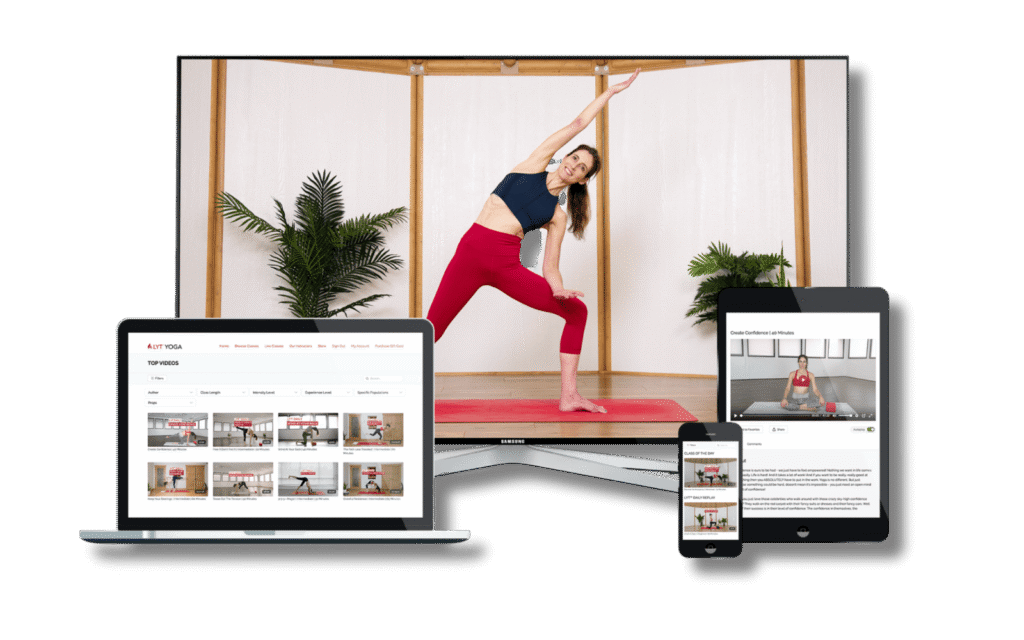
Your Movement Practice, On Demand
Busy schedule? No problem. Access LYT Daily classes anytime, anywhere with our mobile app for Android and iOS. Movement that fits your life.




Start Moving Better Today
A shoulder that moves well but can’t hold steady under load is only half trained. Download this free guide and build the scapular strength and rotator cuff control that makes your shoulders reliable — in the gym, in daily life, and for years to come.

What LYT Students Are Saying
LYT Yoga literally changed my life: my posture, my strength, my balance and my spirit. From rounded shoulders, forward tilted pelvis and text neck to more upright, elongated and powerful way of standing and moving. The relentless discipline in sequencing the class into reset to activate the deep core muscles and then practice of asanas aimed to strengthen, stabilize and improve movement patterns makes wonders. It was a transformational experience for me which made me feel stronger, braver, better and more kind.

Magdalena
Practicing LYT has changed my mind set, my body & my overall well being. My body is so much stronger, I feel more centred & in control of my life & feel I have more of a purpose. You don’t need to be a yogi to practice here. Whatever sport you are doing/playing – practicing on LYT daily will enhance your performance but also give you the ability to do the things you love.

Julie Miller
I used to have imbalances in my body, and it wasn’t until I began to practice yoga on the LYT Daily that I began to heal. I credit the LYT Method’s focus on posture, core integration, and optimal movement in healing my frozen shoulder a couple years ago faster than any other method I had tried. If you are at the beginning or at the end of your healing journey, or if your new or a veteran of yoga, you will find so much content to love & incorporate into your daily movement!

Marci McMahon
Life changing. I met Lara in 2016 and after 5 years as a fitness professional (personal trainer, FMS 1,2, TRX, Kettlebells), I felt like I had met the Ghandi of Movement. I have watched LYT literally transform the world of yoga and movement. I am deeply honored to continue my practice and training with LYT and this knowledge and experience is transformative, energizing, and humbling. LYT changed me inside and out. The connections, community, and CORE values are priceless.
Kristi Rosenberg (Herbert)
Before I found Lara and her brilliant LYT method I was told that I should not practice yoga anymore (after 20 years) because my spine was “such a mess.” I am not only practicing LYT yoga daily, I am also a LYT certified teacher — one of the great joys of my life. LYT helps me keep my core stronger than strong and my spine aligned. I feel so much better because I know how to practice and move in fun, functional and optimal ways. Anything is possible, even doing handstands when you’ve made over 60 trips around the sun!
Julie Glick
Unable to simply get out the car without pain, I was educated by Lara and realised that I could move asymmetrically and not have pain. Even better, that I could do fun movements, challenging ones and big ones! I wasn’t going to end up in a yoga practice which was just restorative yoga. Classical yoga kept me small at this time as I couldn’t do it without pain but with LYT I felt expressive, passionate, energetic and joyful. It gave me a whole new lease on life.

Jane Langan
LYT offers so much variety which is wonderful, and it’s so empowering to get to know your body better how it moves and how it works. I was able to find classes that were perfect to support me through the loss of my mum. I love practicing at home but knowing there is a community of people right behind the screen who I can reach out to. It’s perfect and it just keeps getting better and better.
Nyree Petitjean
Learning smart LYT Yoga has helped me become aware of my daily movement habits (good and bad) both on and off the mat. It has taught me how to move in a more optimal manner. Becoming aware is the first step in making positive changes. I love LYT so much that I became LYT certified and I will continue to learn as much as I can through the ongoing certification programs.

Sharon Henderson
I went through a lot of years of formal medical education, but I have never understood and appreciated the power and resilient capacity of the human body more than I do now as a result of my LYT yoga practice. Every class not only offers safe and joyful movement, but also education that is practical and applicable. I feel secure and continue to grow knowing I can access class anytime time or place, but also the platform is always there no matter where I am physically and emotionally in my life.

Leigh Campbell
Since shifting from a traditional style of yoga practice to LYT Yoga, I have learnt so much more about my body and its function which is so important in a movement practice. The experience is whole, I get to move my body, strengthen and nourish it helping me feel great not only physically but it also brings me so much joy during class that I feel renewed each time. It´s something I look forward to doing everyday like a slice of paradise within my day. And that allows me to be there for those who need me the most.

Stacey Memije
Frequently Questions Answered
What is scapular winging and what causes it?
Scapular winging occurs when the inner border of the shoulder blade lifts away from the ribcage during arm movement or loading. It is primarily caused by weakness or inhibition of the serratus anterior — the muscle that should hold the scapula flat against the ribcage. When the serratus fails, the scapula cannot rotate upward correctly during arm elevation, forcing the shoulder joint to compensate and dramatically increasing impingement risk. Quadruped Weight Shifting and Shoulder Taps in this guide directly address serratus function by loading the shoulder in a position that demands scapular anchoring under body weight.
How do Shoulder Taps train stability differently from a plank?
A standard plank holds both shoulders under equal, symmetrical load. Shoulder Taps create a unilateral stability challenge — each time one hand lifts to tap the opposite shoulder, the remaining arm must support full body weight and resist the rotational force created by the lifted arm. This single-arm loading demand is exactly the kind of asymmetrical challenge the shoulder faces in daily activities like carrying, reaching, and throwing. The key instruction is to maintain completely still hips and shoulders during the tap — any rotation indicates the stabilizers are not managing the load correctly and the movement should be slowed.
What is the Stargazer Barrel Roll and what makes it unique?
The Stargazer Barrel Roll begins in quadruped with one arm lifted and the hip open, turning the body to face the side wall in a Stargazer position. From there, you barrel roll back through quadruped to the other side, maintaining scapular anchoring on the weight-bearing arm throughout. This exercise is unique because it trains open-chain shoulder stability — the bearing shoulder must hold position while the entire body rotates around it. This rotational stability demand is essential for activities like getting up from the floor, yoga transitions, and any sport involving ground contact and rotation.
Why is the lower trapezius so important and why is it so undertrained?
The lower trapezius depresses and posteriorly tilts the scapula — pulling the shoulder blade down and back during arm elevation. This action is essential for creating subacromial space overhead and preventing the shoulder blade from tipping forward, which is the primary mechanism of shoulder impingement. Despite its importance, the lower trapezius is consistently undertrained because most standard exercises — rows, lat pulldowns, and even scapular squeezes — primarily target the middle and upper trapezius. Scapular Elevation/Depression in Side Bridge isolates the lower trapezius by demanding a shrugging-down motion against gravity in side-lying, making it one of the most clinically targeted exercises in this guide.
Can shoulder stability floor exercises help after a shoulder dislocation?
Floor-based shoulder stability exercises are among the most commonly prescribed movements in post-dislocation rehabilitation because they allow progressive loading without the overhead or end-range positions that stress the healing capsule. Quadruped Weight Shifting and Shoulder Taps are typically introduced early in rehabilitation. Side Plank progressions are added as stability improves. However, post-dislocation rehabilitation requires individual assessment and timing guidance from a physical therapist — the specific exercises appropriate depend on the severity of the injury, the direction of dislocation, and the stage of healing. This guide is best used under PT guidance for post-dislocation recovery.
How do I know if I'm doing Modified Side Plank correctly?
The key indicator of correct Modified Side Plank is the position of the weight-bearing scapula. It should remain anchored — drawn down toward the hip — throughout the exercise. If the shoulder shrugs upward toward the ear, the upper trapezius is compensating for insufficient lower trapezius and serratus strength. The body should form a straight diagonal line from the knee through the hip to the shoulder. During the Backstroke variation, the moving arm should sweep in a full arc while the shoulder angle at the mat remains completely still. Any rotation in the torso toward the floor indicates the stabilizers are fatiguing and the set should end.
How quickly can shoulder stability exercises resolve clicking and catching sensations?
Shoulder clicking during movement is usually caused by the scapula tracking incorrectly — either winging away from the ribcage or tipping forward — which causes structures in the subacromial space to snap across one another. Improved scapular control through exercises like Quadruped Weight Shifting and Scapular Depression can begin to reduce clicking within two to three weeks of consistent practice. The timeline depends on the severity of the tracking issue and how consistently the exercises are performed. For most people with functional clicking (no structural damage), daily practice of this guide produces noticeable reduction in catching and snapping within the first month.
LYT YOGA Instructors
Our instructors are more than just experts of movement, they understand the body’s mechanics and guide you every step of the way to achieve your goals.
- Instructor
Lara Heimann
Lara Heimann
- Instructor
Kristin Williams
Kristin Williams
- Instructor
Rhonna Griffin
Rhonna Griffin
- Instructor
Teagan Schweitzer
Teagan Schweitzer
- Instructor
Brenda Lawer
Brenda Lawer
- Instructor
Poppy Zahn
Poppy Zahn
- Instructor
Sharon Tyrrell
Sharon Tyrrell
- Instructor
Jessica Hensley
Jessica Hensley
- Instructor
Katrina Latimer
Katrina Latimer
- Instructor
Jeremy Engel
Jeremy Engel
- Instructor
Shefali Shah
Shefali Shah
- Instructor
Campbell Will
Campbell Will
- Instructor
Maria Webb
Maria Webb
- Instructor
Megan Spears
Megan Spears
- Instructor
Paola Ricardo
Paola Ricardo
- Instructor
Ashley Newton
Ashley Newton
- Instructor
Michelle Onion
Michelle Onion
Download Your FREE Shoulder Stability Floor Guide
Join thousands who’ve transformed their movement with the LYT Yoga Method. Get instant access to your complete shoulder stability floor guide — PT-designed to build the scapular strength and rotator cuff control that protects your shoulders for life.
What You'll Get:
- 6 floor-based shoulder stability exercises targeting scapular anchoring and rotator cuff control
- Professional photographs with precise positioning and alignment cues
- Anatomical explanations connecting each exercise to specific shoulder protection benefits
- PT-designed progressions from basic scapular loading to dynamic stability challenges
- Guidance on activating the serratus anterior and lower trapezius correctly
- Tips for integrating floor stability work with your existing shoulder training
Get Instant Access
- Delivered Straight to Your Inbox
- Your data is 100% Private
- Join 50,000+ LYT Practitioners
