

LYT YOGA PDF Guides:
FREE Shoulder Mobility Standing Exercises
- Full Overhead Range: Restore the shoulder's ability to reach, press, and lift without restriction
- Posture Reset: Open the chest and retrain the shoulder blades to sit where they belong
- Expert Guidance: Created by Lara Heimann, PT and LYT Founder
- No Equipment: 8 standing exercises — do them anywhere, anytime
Program Overview:
15+
Exercises
10-15
min/ day
0 Machine
Needed
Perfect For:
Anyone whose shoulders round forward, people who can't reach overhead without pain or pinching, desk workers, overhead athletes, or anyone who wants to move their arms freely through daily life.
PT-Designed
Evidence-based movements
Functional Focus
Real-world daily applications
Brain Mapping
Retrain movement patterns
Immediate Results
Feeling better from day one
Standing Shoulder Mobility — Trained Where You Use It
Your shoulders spend most of the day in upright, loaded positions. Standing mobility exercises train the scapula, rotator cuff, and thoracic spine to move freely exactly where that freedom matters most — while you’re on your feet.
- Scapular Rhythm: Rolls, Shrugs, and Scapular Squeezes retrain the shoulder blade's full movement range
- Overhead Access: Bilateral Flexion/Extension and Goddess Abduction restore the full upward arc of arm elevation
- Rotational Freedom: Arm Swings in Lunge train the shoulder through dynamic circumduction with thoracic support
- Scapular Retraction: Goal Post and W Squeezes rebuild the mid-back strength that holds the shoulders back
- Lateral Range: One Arm Abduction with side bending opens the shoulder and lateral spine simultaneously


Why Rounded Shoulders Are a Mobility Problem — Not Just a Posture Problem
Rounded shoulders are not a sign of weakness — they’re a sign of restricted thoracic mobility and shortened anterior shoulder tissues. Cueing yourself to ‘stand up straight’ doesn’t fix it. Restoring the range does.
- Open the Chest: Scapular Squeezes and Bilateral Extension directly reverse the forward-rounded position
- Decompress the Neck: Improved scapular positioning reduces the pull on the cervical spine and base of skull
- Restore Shoulder Rotation: Standing abduction work retrains the rotator cuff to control the full overhead arc
- Improve Athletic Power: Free shoulders generate more force in throwing, swimming, climbing, and pressing
- Look and Feel Taller: Better scapular position creates immediate visible postural improvement
Shoulders Built to Move in Every Directionwith LYT Yoga Method
Overhead Freedom
Reach without restriction. Bilateral Flexion/Extension and Goddess Shoulder Abduction restore the full upward arc — training the rotator cuff and serratus to control elevation smoothly and pain-free.
Scapular Reset
Put the shoulder blade back where it belongs. Goal Post and W Scapular Squeezes rebuild the mid-back strength that pulls rounded shoulders open — creating the foundation for every arm movement.
Dynamic Range
Train mobility in motion, not just in holds. Arm Swings in Lunge move the shoulder through full circumduction while the thoracic spine rotates — building the dynamic range daily life and sport demand.
Side-Body Release
Open the lateral shoulder and spine together. One Arm Abduction with lateral spinal bending frees the structures that limit full overhead reach from the side — the direction most stretching programs ignore.
Explore More classes and programs
Shoulders are just the start. Explore LYT programs for spine health, core strength, hip mobility, and total-body functional movement.
Online classes
Teacher training
Corporate
Individual and Group Private sessions
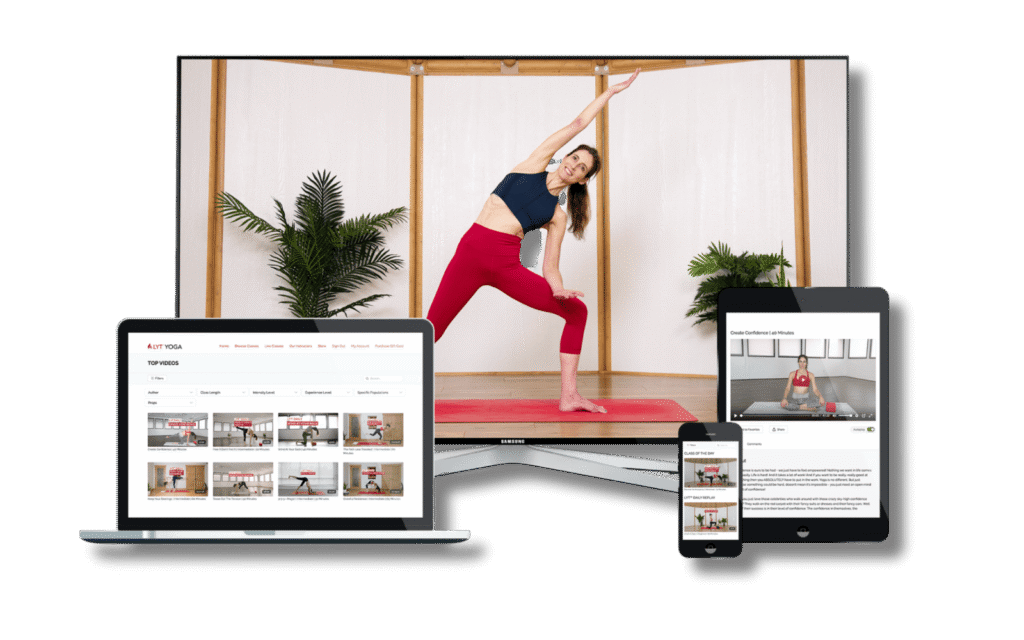
Your Movement Practice, On Demand
Busy schedule? No problem. Access LYT Daily classes anytime, anywhere with our mobile app for Android and iOS. Movement that fits your life.




Start Moving Better Today
Every reach, press, and throw starts with a mobile shoulder. Download this free guide and reclaim the full range of motion that makes moving your arms feel easy, natural, and completely pain-free.

What LYT Students Are Saying
LYT Yoga literally changed my life: my posture, my strength, my balance and my spirit. From rounded shoulders, forward tilted pelvis and text neck to more upright, elongated and powerful way of standing and moving. The relentless discipline in sequencing the class into reset to activate the deep core muscles and then practice of asanas aimed to strengthen, stabilize and improve movement patterns makes wonders. It was a transformational experience for me which made me feel stronger, braver, better and more kind.

Magdalena
Practicing LYT has changed my mind set, my body & my overall well being. My body is so much stronger, I feel more centred & in control of my life & feel I have more of a purpose. You don’t need to be a yogi to practice here. Whatever sport you are doing/playing – practicing on LYT daily will enhance your performance but also give you the ability to do the things you love.
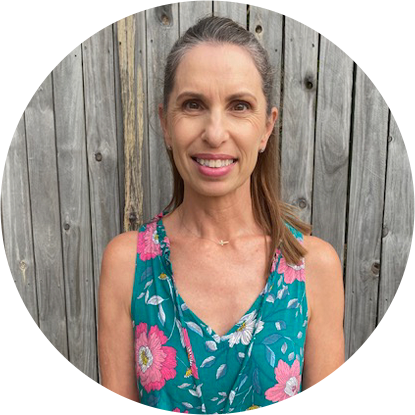
Julie Miller
I used to have imbalances in my body, and it wasn’t until I began to practice yoga on the LYT Daily that I began to heal. I credit the LYT Method’s focus on posture, core integration, and optimal movement in healing my frozen shoulder a couple years ago faster than any other method I had tried. If you are at the beginning or at the end of your healing journey, or if your new or a veteran of yoga, you will find so much content to love & incorporate into your daily movement!
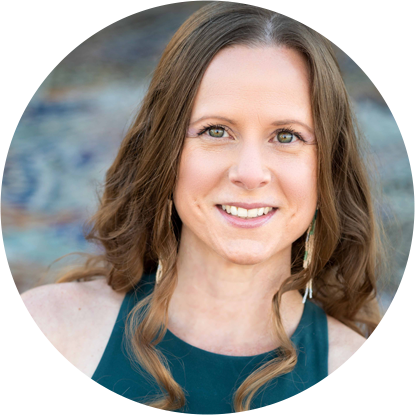
Marci McMahon
Life changing. I met Lara in 2016 and after 5 years as a fitness professional (personal trainer, FMS 1,2, TRX, Kettlebells), I felt like I had met the Ghandi of Movement. I have watched LYT literally transform the world of yoga and movement. I am deeply honored to continue my practice and training with LYT and this knowledge and experience is transformative, energizing, and humbling. LYT changed me inside and out. The connections, community, and CORE values are priceless.
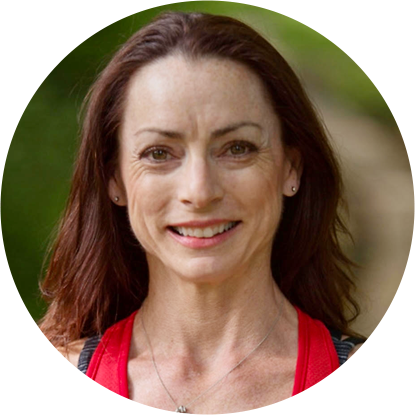
Kristi Rosenberg (Herbert)
Before I found Lara and her brilliant LYT method I was told that I should not practice yoga anymore (after 20 years) because my spine was “such a mess.” I am not only practicing LYT yoga daily, I am also a LYT certified teacher — one of the great joys of my life. LYT helps me keep my core stronger than strong and my spine aligned. I feel so much better because I know how to practice and move in fun, functional and optimal ways. Anything is possible, even doing handstands when you’ve made over 60 trips around the sun!
Julie Glick
Unable to simply get out the car without pain, I was educated by Lara and realised that I could move asymmetrically and not have pain. Even better, that I could do fun movements, challenging ones and big ones! I wasn’t going to end up in a yoga practice which was just restorative yoga. Classical yoga kept me small at this time as I couldn’t do it without pain but with LYT I felt expressive, passionate, energetic and joyful. It gave me a whole new lease on life.
Jane Langan
LYT offers so much variety which is wonderful, and it’s so empowering to get to know your body better how it moves and how it works. I was able to find classes that were perfect to support me through the loss of my mum. I love practicing at home but knowing there is a community of people right behind the screen who I can reach out to. It’s perfect and it just keeps getting better and better.
Nyree Petitjean
Learning smart LYT Yoga has helped me become aware of my daily movement habits (good and bad) both on and off the mat. It has taught me how to move in a more optimal manner. Becoming aware is the first step in making positive changes. I love LYT so much that I became LYT certified and I will continue to learn as much as I can through the ongoing certification programs.
Sharon Henderson
I went through a lot of years of formal medical education, but I have never understood and appreciated the power and resilient capacity of the human body more than I do now as a result of my LYT yoga practice. Every class not only offers safe and joyful movement, but also education that is practical and applicable. I feel secure and continue to grow knowing I can access class anytime time or place, but also the platform is always there no matter where I am physically and emotionally in my life.
Leigh Campbell
Since shifting from a traditional style of yoga practice to LYT Yoga, I have learnt so much more about my body and its function which is so important in a movement practice. The experience is whole, I get to move my body, strengthen and nourish it helping me feel great not only physically but it also brings me so much joy during class that I feel renewed each time. It´s something I look forward to doing everyday like a slice of paradise within my day. And that allows me to be there for those who need me the most.

Stacey Memije
Frequently Questions Answered
What causes shoulders to round forward and lose mobility over time?
Prolonged sitting and screen use keep the arms in a forward position for hours, causing the anterior shoulder muscles — pectoralis minor, subscapularis, and anterior deltoid — to adaptively shorten. Simultaneously, the mid-back muscles responsible for scapular retraction become neurologically inhibited from being in a lengthened, unloaded position. The result is a self-reinforcing cycle: tight front, weak back, and progressively less range of motion available in the shoulder joint. The LYT standing exercises target both sides of this equation — restoring anterior tissue length through abduction and extension work while rebuilding scapular retractor strength through Goal Post and W Squeezes.
What is scapular rhythm and why does it matter?
Scapulohumeral rhythm refers to the coordinated ratio of scapular rotation to glenohumeral (ball-and-socket) movement during arm elevation. For every 2 degrees the arm moves upward, the scapula should rotate approximately 1 degree. When this rhythm is disrupted — due to scapular weakness, thoracic stiffness, or rotator cuff dysfunction — the shoulder joint runs out of room at the top of elevation, causing impingement, pinching, and pain. Shoulder Rolls, Shrugs, and Abduction exercises in this guide specifically retrain this rhythm by encouraging the scapula to move in coordination with the arm rather than remaining fixed.
How do Scapular Squeezes in Goal Post and W positions differ?
Both exercises train scapular retraction — pulling the shoulder blades toward the spine — but from different arm positions that target the mid-back muscles differently. Goal Post position (elbows at 90 degrees, upper arms parallel to the floor) primarily targets the middle trapezius and rhomboids. The W position (arms lower, elbows bent more acutely) recruits the lower trapezius more heavily — the muscle most responsible for scapular depression and the one most commonly inhibited in people with shoulder impingement. Including both positions ensures comprehensive scapular stabilizer training rather than overloading one portion of the trapezius.
Why are the shoulder exercises performed in Goddess position?
The Goddess position — wide stance with knees and toes turned out — stabilizes the lower body and pelvis, allowing the upper body to be the primary focus of the exercise. In Goddess, the hips and knees are in a predictable, stable position that removes the temptation to generate shoulder movement by shifting the trunk or pelvis. This makes overhead abduction work more precise and honest — the range you can achieve in Goddess position is true shoulder range, not range borrowed from the lower back or hip. It also creates a slight load in the lower body that trains shoulder mobility under mild whole-body demand.
Can these exercises help with shoulder impingement?
Many of these exercises are used in physical therapy for shoulder impingement because they address the two primary mechanical causes: poor scapular control and restricted shoulder rotation. Shoulder Rolls, Scapular Squeezes, and Bilateral Flexion/Extension are typically well-tolerated and therapeutically valuable for impingement. However, exercises that load the shoulder at end-range overhead — particularly Goddess Shoulder Abduction — may provoke symptoms in acute impingement and should be performed within a pain-free range only. Anyone with diagnosed impingement should work within their comfort zone and consult a PT for personalized guidance.
How does Arm Swings in Lunge differ from standard arm swings?
Arm Swings in Lunge are performed in a Crescent Lunge or Warrior 1 position with one heel down and the core engaged. The key distinction is the requirement to stabilize through the core so nothing in the lower half changes while alternating arm swings occur. This demands that the shoulder joint and thoracic spine do all the work — no trunk rotation, no hip shifting, no momentum cheating. The result is a dynamic shoulder circumduction exercise that trains full range in a controlled, isolated manner. The lunge position also opens the hip flexors, making this a two-for-one exercise that serves the whole body.
How long does it take to see posture improvement from shoulder mobility exercises?
Visible posture improvement can occur within a single session — particularly from Scapular Squeezes and Bilateral Extension, which immediately recalibrate the shoulder blade’s resting position. This initial change is neurological, reflecting altered muscle tone rather than structural remodeling. Lasting postural change — where the shoulders habitually sit further back and the chest remains open without conscious effort — typically consolidates within four to six weeks of daily practice. Consistency is the primary variable: daily practice produces results significantly faster than occasional sessions.
LYT YOGA Instructors
Our instructors are more than just experts of movement, they understand the body’s mechanics and guide you every step of the way to achieve your goals.
- Instructor
Lara Heimann
Lara Heimann
- Instructor
Kristin Williams
Kristin Williams
- Instructor
Rhonna Griffin
Rhonna Griffin
- Instructor
Teagan Schweitzer
Teagan Schweitzer
- Instructor
Brenda Lawer
Brenda Lawer
- Instructor
Poppy Zahn
Poppy Zahn
- Instructor
Sharon Tyrrell
Sharon Tyrrell
- Instructor
Jessica Hensley
Jessica Hensley
- Instructor
Katrina Latimer
Katrina Latimer
- Instructor
Jeremy Engel
Jeremy Engel
- Instructor
Shefali Shah
Shefali Shah
- Instructor
Campbell Will
Campbell Will
- Instructor
Maria Webb
Maria Webb
- Instructor
Megan Spears
Megan Spears
- Instructor
Paola Ricardo
Paola Ricardo
- Instructor
Ashley Newton
Ashley Newton
- Instructor
Michelle Onion
Michelle Onion
Download Your FREE Shoulder Mobility Standing Guide
Join thousands who’ve transformed their movement with the LYT Yoga Method. Get instant access to your complete shoulder mobility standing guide — PT-designed to restore overhead range, open the chest, and end shoulder tension for good.
What You'll Get:
- 8 standing shoulder mobility exercises covering full range in every direction
- Professional photographs with precise alignment and form cues
- Anatomical explanations of scapular rhythm and shoulder mechanics
- PT-designed sequencing from scapular activation to dynamic full-range movement
- Guidance on when and how to use these exercises — warm-up, daily practice, or desk break
- Modifications for those with limited range or shoulder sensitivity
Get Instant Access
- Delivered Straight to Your Inbox
- Your data is 100% Private
- Join 50,000+ LYT Practitioners
