One of our original core taglines for LYT Yoga® is “Smart Yoga.” What makes it smart? It comes down to one thing: following the neurodevelopmental sequence in yoga from beginning to end.
What Is the Neurodevelopmental Sequence?
The neurodevelopmental sequence in yoga is the normal movement progression that babies follow as they learn to roll, sit, crawl, stand, and walk. This developmental movement progression is foundational to human movement.
Many rehab professionals and physical therapists use this sequence to safely progress patients in a clinical rehabilitation setting.
The more basic developmental postures provide the necessary strength, stability, mobility, and coordination required for the higher developmental postures.
The milestones babies reach on their way to standing form the basic premise of neurodevelopmental sequencing.
In infants, the sequence typically follows this progression:
Lying on Their Back → Head and Neck Control on Their Belly → Rolling → Grasping → Sitting → Quadruped (Hands and Knees) → Crawling → Tall Kneeling → Half Kneeling → Standing → Walking
Each stage builds on the one before it. Skipping a level can create compensation patterns, poor posture, and increased risk of injury later in life.
Neurodevelopmental Sequence in Adults and Functional Training
When we apply the neurodevelopmental sequence to adults in a rehab or functional movement training setting, we may modify certain components.
For example, most adults can hold up their heads, but that doesn’t mean we eliminate head and neck control entirely, as many people lack optimal cervical alignment and posture.
The same is true with grasping. While we don’t need to teach adults how to hold objects, we often need to retrain how the hands function in weight-bearing positions like Plank or Down Dog.
Skipping developmental levels, whether in rehab, strength training, or yoga, can leave people without the foundational strength and stability needed for higher-level movement.
Without these basic building blocks, injury risk increases.
Each developmental posture acts as a stepping stone, helping build correct posture, balance, mobility, and core stability before progressing to the next level.
How LYT Yoga® Follows the Neurodevelopmental Sequence
So how does this translate to LYT Yoga®?
Every single time you get on your mat, we follow the neurodevelopmental sequence.
We begin every class with the Reset for a reason. Within the Reset alone, we move through:
Bridge (Supine) → Ab Work (Supine) → Supine Twist (Rolling) → Cat/Cow (Quadruped) → Dolphin (Quadruped) → Half Kneeling/Standing (Sun Salutation 1)
With Bridge and Ab Work, we prepare the body at its lowest developmental level. This allows us to neutralize the pelvis, activate the posterior chain, and heat up the core cylinder without the added demand of balance or high-level stability.
The LYT version of Supine Twist is intentionally active, not passive. In adults, rolling strategies are underused and often deficient. This movement restores coordinated force transfer between the legs, trunk, and arms.
The movement initiates at the leg (pressing the inner edge of the foot into the mat), transmits through the core, and stabilizes through the shoulder blades. This is functional movement training at its most fundamental level.
Moving into Cat/Cow and/or Dolphin progresses the body into Quadruped, where stability through both the hip and shoulder girdles is required. This demands activation of the proximal stabilizers of the pelvis, scapulothoracic region, and spine.
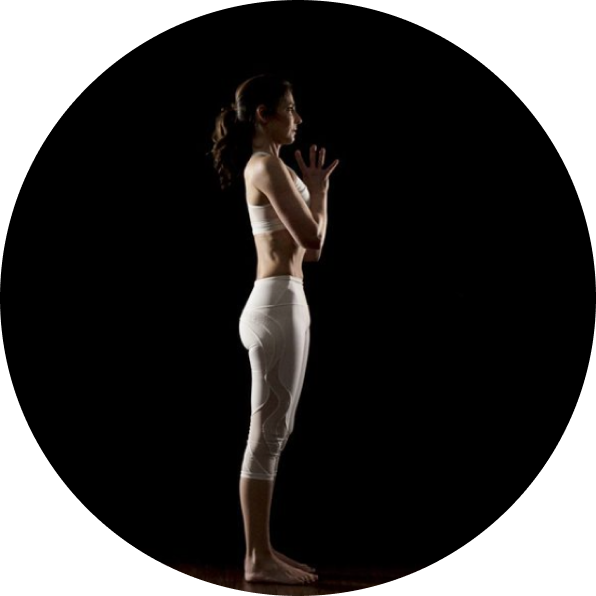
Finally, Sun Salutation 1 progresses us into Half Kneeling (Low Lunge) and Standing (Tadasana), continuing the neurodevelopmental progression.
In my Beginners classes, I often add Tall Kneeling between Down Dog and Low Lunge. Many students lack the hip mobility, strength, or motor control to step forward with precision, and this intermediate developmental posture helps bridge the gap safely.
From Simple to Complex: Progressive Sequencing in LYT Yoga®
Another principle of neurodevelopmental sequencing is progressing from simple to complex.
This is where the Sequences and the Stream come into play.
In every LYT Yoga® class, you’ll notice a progressive increase in difficulty and complexity from one Sequence to the next, culminating in the Stream, where we layer in additional challenges. Repetition is how we learn. Strategic variation is how we grow.
This intentional progression transforms every LYT Yoga® class into a therapeutic rehabilitation and functional movement training session.
It’s smart because it’s intentional. It’s smart because it’s progressive. It’s smart because it follows the neurodevelopmental sequence.
Learn the LYT Yoga® Method
If you’re interested in learning how to teach the LYT Yoga® Method or simply want to deepen your knowledge of biomechanics, injury prevention, and intelligent movement, we have our next online teacher training cohort beginning on March 1.
Click the link for more details.