

LYT YOGA PDF Guides:
FREE Hip Mobility Standing Exercises
Unlock fluid movement and eliminate hip stiffness with evidence-based exercises from a licensed physical therapist.
- Functional Movement: Restore natural hip patterns for daily activities
- Pain-Free Motion: Reduce discomfort and increase range of motion
- Expert Guidance: Created by Lara Heimann, PT and LYT Founder
- Quick & Effective: Exercises designed for busy lifestyles
Program Overview:
15+
Exercises
10-15
min/ day
0 Machine
Needed
Perfect For:
Anyone experiencing hip stiffness from sitting, lower back pain from tight hips, athletes seeking more power and range, or anyone wanting to move through daily activities with greater ease and freedom.
PT-Designed
Evidence-based movements
Functional Focus
Real-world daily applications
Brain Mapping
Retrain movement patterns
Immediate Results
Feeling better from day one
Transform Your Hip Mobility with LYT
Hip mobility is the foundation of functional movement. When your hips move freely, everything else follows, from your walk to your workouts.
- Evidence-Based Approach: Grounded in physical therapy and neuroscience
- Progressive Sequences: Build mobility gradually and safely
- Standing Focus: Practical exercises you can do anywhere
- Visual Instructions: Clear photos and detailed cues
- Body Awareness: Learn to feel and understand your movement


Why Hip Mobility Matters
Tight hips don’t just limit your movement—they create compensation patterns that lead to pain in your back, knees, and beyond.
- Prevent Lower Back Pain: Mobile hips reduce spinal stress
- Improve Athletic Performance: Power and speed start at the hips
- Enhance Daily Function: Walk, sit, and move with ease
- Age Gracefully: Maintain independence through movement
- Feel Better Now: Relief starts with your first session
Unlock Pain-Free Movement with LYT Yoga Method
Functional Mobility
Restore natural hip range. Move freely through daily activities without stiffness or compensation patterns.
Pain Prevention
Eliminate lower back stress. Address the root cause of discomfort by freeing restricted hip joints.
Performance Power
Generate athletic force. Improve speed, agility, and explosive strength from your body's power center.
Lifelong Independence
Age with confidence. Maintain the mobility you need to walk, squat, and move well for decades.
Explore More classes and programs
Hip mobility is just the beginning. Discover specialized programs for core strength, spine health, shoulder stability, and total-body functional movement.
Online classes
Teacher training
Corporate
Individual and Group Private sessions
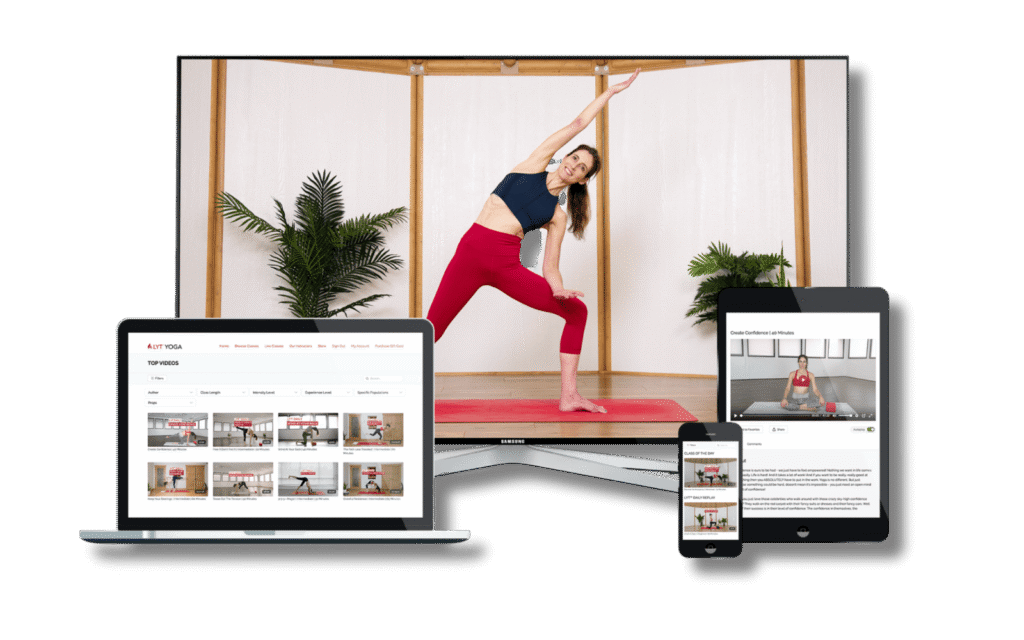
Your Movement Practice, On Demand
Busy schedule? No problem. Access LYT Daily classes anytime, anywhere with our mobile app for Android and iOS. Movement that fits your life.




Start Moving Better Today
Don’t let another day pass with tight hips holding you back. Download this free guide and take the first step toward pain-free movement, increased mobility, and a body that feels as good as it performs. Join thousands who’ve transformed their movement with LYT Yoga Method.

What LYT Students Are Saying
LYT Yoga literally changed my life: my posture, my strength, my balance and my spirit. From rounded shoulders, forward tilted pelvis and text neck to more upright, elongated and powerful way of standing and moving. The relentless discipline in sequencing the class into reset to activate the deep core muscles and then practice of asanas aimed to strengthen, stabilize and improve movement patterns makes wonders. It was a transformational experience for me which made me feel stronger, braver, better and more kind.

Magdalena
Practicing LYT has changed my mind set, my body & my overall well being. My body is so much stronger, I feel more centred & in control of my life & feel I have more of a purpose. You don’t need to be a yogi to practice here. Whatever sport you are doing/playing – practicing on LYT daily will enhance your performance but also give you the ability to do the things you love.

Julie Miller
I used to have imbalances in my body, and it wasn’t until I began to practice yoga on the LYT Daily that I began to heal. I credit the LYT Method’s focus on posture, core integration, and optimal movement in healing my frozen shoulder a couple years ago faster than any other method I had tried. If you are at the beginning or at the end of your healing journey, or if your new or a veteran of yoga, you will find so much content to love & incorporate into your daily movement!

Marci McMahon
Life changing. I met Lara in 2016 and after 5 years as a fitness professional (personal trainer, FMS 1,2, TRX, Kettlebells), I felt like I had met the Ghandi of Movement. I have watched LYT literally transform the world of yoga and movement. I am deeply honored to continue my practice and training with LYT and this knowledge and experience is transformative, energizing, and humbling. LYT changed me inside and out. The connections, community, and CORE values are priceless.

Kristi Rosenberg (Herbert)
Before I found Lara and her brilliant LYT method I was told that I should not practice yoga anymore (after 20 years) because my spine was “such a mess.” I am not only practicing LYT yoga daily, I am also a LYT certified teacher — one of the great joys of my life. LYT helps me keep my core stronger than strong and my spine aligned. I feel so much better because I know how to practice and move in fun, functional and optimal ways. Anything is possible, even doing handstands when you’ve made over 60 trips around the sun!

Julie Glick
Unable to simply get out the car without pain, I was educated by Lara and realised that I could move asymmetrically and not have pain. Even better, that I could do fun movements, challenging ones and big ones! I wasn’t going to end up in a yoga practice which was just restorative yoga. Classical yoga kept me small at this time as I couldn’t do it without pain but with LYT I felt expressive, passionate, energetic and joyful. It gave me a whole new lease on life.

Jane Langan
LYT offers so much variety which is wonderful, and it’s so empowering to get to know your body better how it moves and how it works. I was able to find classes that were perfect to support me through the loss of my mum. I love practicing at home but knowing there is a community of people right behind the screen who I can reach out to. It’s perfect and it just keeps getting better and better.
Nyree Petitjean
Learning smart LYT Yoga has helped me become aware of my daily movement habits (good and bad) both on and off the mat. It has taught me how to move in a more optimal manner. Becoming aware is the first step in making positive changes. I love LYT so much that I became LYT certified and I will continue to learn as much as I can through the ongoing certification programs.

Sharon Henderson
I went through a lot of years of formal medical education, but I have never understood and appreciated the power and resilient capacity of the human body more than I do now as a result of my LYT yoga practice. Every class not only offers safe and joyful movement, but also education that is practical and applicable. I feel secure and continue to grow knowing I can access class anytime time or place, but also the platform is always there no matter where I am physically and emotionally in my life.

Leigh Campbell
Since shifting from a traditional style of yoga practice to LYT Yoga, I have learnt so much more about my body and its function which is so important in a movement practice. The experience is whole, I get to move my body, strengthen and nourish it helping me feel great not only physically but it also brings me so much joy during class that I feel renewed each time. It´s something I look forward to doing everyday like a slice of paradise within my day. And that allows me to be there for those who need me the most.

Stacey Memije
Hip Mobility & The LYT Yoga Method Frequently Questions Answered
1. Why are my hips so tight from sitting all day, and can standing exercises really help?
Prolonged sitting causes your hip flexor muscles to remain in a shortened position for hours, reducing blood flow and causing the tissues to adapt to this compressed state. When you sit, muscles like the iliopsoas and rectus femoris stay contracted, which over time leads to stiffness, reduced range of motion, and compensatory stress on your lower back and knees. Standing hip mobility exercises are particularly effective because they restore functional movement patterns in weight-bearing positions—the same positions you use in daily life. The LYT Method’s standing exercises are designed by a physical therapist to retrain your brain’s movement patterns (brain mapping) while you’re upright, making the mobility gains immediately transferable to activities like walking, climbing stairs, and getting up from a chair.
Unlike floor-based stretches, standing exercises engage stabilizing muscles simultaneously, creating both mobility and strength in a functional context.
2. How does the LYT Yoga Method differ from traditional yoga when it comes to hip mobility?
The LYT Yoga Method was created by licensed physical therapist Lara Heimann and uniquely integrates evidence-based physical therapy principles with yoga practice. While traditional yoga often focuses primarily on postures and breathing techniques, LYT prioritizes anatomical alignment, optimal movement patterns, and neurodevelopmental training to retrain habitual compensations. For hip mobility specifically, LYT sequences are structured to prepare the body progressively warming up the nervous system, activating stabilizers, then safely deepening range of motion.
This approach is grounded in understanding the hip joint’s 27 crossing muscles and how they function in kinetic chain movements. The method emphasizes brain mapping, which helps your nervous system relearn efficient movement patterns rather than just passively stretching tight tissues. This physical therapy foundation makes LYT especially effective for people recovering from injuries, experiencing chronic pain, or wanting to prevent future problems while building sustainable mobility.
3. Can hip mobility exercises really reduce lower back pain, and how long does it take to see results?
Yes, improving hip mobility can significantly reduce lower back pain because the hips and lumbar spine work as an interconnected system. When hip mobility is restricted—particularly in hip flexion, extension, and rotation—the lower back compensates by moving excessively to make up for the hips’ limited range. This compensation creates abnormal stress on the lumbar spine’s joints, discs, and muscles, often resulting in pain and stiffness. Physical therapy research shows that restoring hip mobility helps distribute movement forces more evenly across the pelvis and spine, reducing concentrated stress on the lower back. Most people notice initial improvements in hip range of motion within two to four weeks when practicing targeted exercises three to five times per week. However, the timeline varies based on your current flexibility, consistency, and the severity of tightness.
With the LYT Method’s progressive approach, many practitioners report feeling reduced stiffness and increased ease of movement within the first week, with more substantial pain relief developing as the nervous system adapts to healthier movement patterns over 4-8 weeks.
4. What is "brain mapping" in the LYT Yoga Method, and why does it matter for hip mobility?
Brain mapping, also called motor mapping or neuromuscular patterning, refers to how your brain creates and stores movement blueprints that control your muscles and joints. Every movement you make repeatedly becomes encoded in your nervous system as a pattern. When you have poor hip mobility or compensatory movement habits (like using your lower back instead of your hips), your brain has mapped these inefficient patterns as “normal.” The LYT Yoga Method uses principles from Neurodevelopmental Treatment (NDT)—a specialized physical therapy approach—to actively retrain these patterns. By performing hip mobility exercises with specific attention to proper sequencing, alignment, and controlled movement, you’re essentially teaching your brain new, healthier ways to move.
This is why LYT emphasizes moving through exercises slowly and mindfully rather than rushing through repetitions. The standing focus of many LYT hip exercises is particularly powerful for brain mapping because your nervous system learns mobility in the same weight-bearing positions you use daily, making the new patterns stick and transfer automatically to real-world movements like walking, squatting, and bending.
5. I'm not flexible at all, are standing hip mobility exercises suitable for beginners?
Absolutely! Standing hip mobility exercises are often more accessible for beginners than floor-based stretches because they allow you to control the intensity more easily and maintain better balance. The LYT Method specifically designs exercises for all levels, with modifications that meet you where you are. Standing positions also engage your stabilizing muscles, which provides natural support and safety while you work on increasing range of motion. If you have very tight hips, you can start with smaller movements and gradually progress as your mobility improves—there’s no requirement to achieve full range immediately. Physical therapists actually prefer standing exercises for many beginners because they’re functional (mimicking daily activities) and less intimidating than getting down to the floor.
The key is consistency over intensity: even 10-15 minutes of gentle standing hip mobility work several times per week will yield better results than occasional aggressive stretching. The LYT approach emphasizes quality of movement and proper form over pushing into pain, which makes it sustainable and safe for people at any starting point, including those recovering from injuries or managing chronic conditions.
6. How do hip mobility exercises improve athletic performance, and which sports benefit most?
Hip mobility is fundamental to athletic performance because the hips are your body’s power center they generate force for explosive movements and transfer energy between your upper and lower body. When hip mobility is limited, you lose access to full range of motion, which reduces power output, shortens stride length, compromises stability, and increases injury risk. Athletes with optimal hip mobility can generate greater force from the glutes and hip extensors, achieve better positions for movements like squatting and lunging, and move more efficiently with less wasted energy. Sports that particularly benefit from enhanced hip mobility include running (improved stride length and reduced lower back compensation), tennis and golf (better rotational power through the hips), martial arts (higher kicks and deeper stances), CrossFit and Olympic lifting (optimal squat depth and hip hinge mechanics), soccer (improved kicking power and agility), and yoga (deeper poses and safer transitions).
The LYT Method’s standing hip exercises are especially valuable for athletes because they train mobility while simultaneously engaging stabilizers, creating what’s called “functional range of motion” mobility you can actually use and control under load, not just passive flexibility.
7. What's the difference between hip mobility and hip flexibility, and which one should I focus on?
Hip mobility and flexibility are related but distinct concepts, and understanding the difference is crucial for effective training.
Flexibility refers to the passive length of your muscles and connective tissues; how far your hip can move when external force is applied (like a partner pushing your leg into a stretch).
Mobility, on the other hand, is your ability to actively control movement through a range of motion using muscle strength and neuromuscular coordination. You can be flexible without being mobile, which actually increases injury risk because you can access ranges your muscles can’t stabilize or control.
The LYT Method emphasizes mobility over passive flexibility because functional movement requires both range of motion AND the strength to control that range. This physical therapy approach focuses on training your hips to move actively through their full range while maintaining stability and proper alignment—which is exactly what you need for daily activities, sports, and injury prevention. For most people, especially those who sit frequently or experience hip tightness, developing active hip mobility through controlled, strengthening-based movements is far more beneficial than simply stretching to increase passive flexibility. LYT’s standing exercises build this type of functional mobility by challenging your hips to move through multiple planes of motion while your muscles actively support the movement.
LYT YOGA Instructors
Our instructors are more than just experts of movement, they understand the body’s mechanics and guide you every step of the way to achieve your goals.
- Instructor
Lara Heimann
Lara Heimann
- Instructor
Kristin Williams
Kristin Williams
- Instructor
Rhonna Griffin
Rhonna Griffin
- Instructor
Teagan Schweitzer
Teagan Schweitzer
- Instructor
Brenda Lawer
Brenda Lawer
- Instructor
Poppy Zahn
Poppy Zahn
- Instructor
Sharon Tyrrell
Sharon Tyrrell
- Instructor
Jessica Hensley
Jessica Hensley
- Instructor
Katrina Latimer
Katrina Latimer
- Instructor
Jeremy Engel
Jeremy Engel
- Instructor
Shefali Shah
Shefali Shah
- Instructor
Campbell Will
Campbell Will
- Instructor
Maria Webb
Maria Webb
- Instructor
Megan Spears
Megan Spears
- Instructor
Paola Ricardo
Paola Ricardo
- Instructor
Ashley Newton
Ashley Newton
- Instructor
Michelle Onion
Michelle Onion
Download Your FREE Hip Mobility Guide
Join thousands who’ve transformed their movement with the LYT Yoga Method. Get instant access to your comprehensive hip mobility guide.
What You'll Get:
- 15+ standing hip mobility exercises with detailed instructions
- Professional photographs demonstrating proper form
- Anatomical explanations for each movement
- Progressive sequences for all fitness levels
- Tips for integrating exercises into your daily routine
- Common mistakes to avoid for safe practice
Get Instant Access
- Delivered Straight to Your Inbox
- Your data is 100% Private
- Join 50,000+ LYT Practitioners
