
Downward Dog alignment is not about making every body look the same. It is about examining how the body organizes force, connects through the center, and adapts within the pose.
I recently posted a before-and-after photo of a former teacher trainee’s transformation in Downward Dog (Adho Mukha Svanasana), followed by two questions:
- Why do you think the “after” photo is more integrated than the first?
- Why do so many people practice Down Dog as seen in the “before” photo?
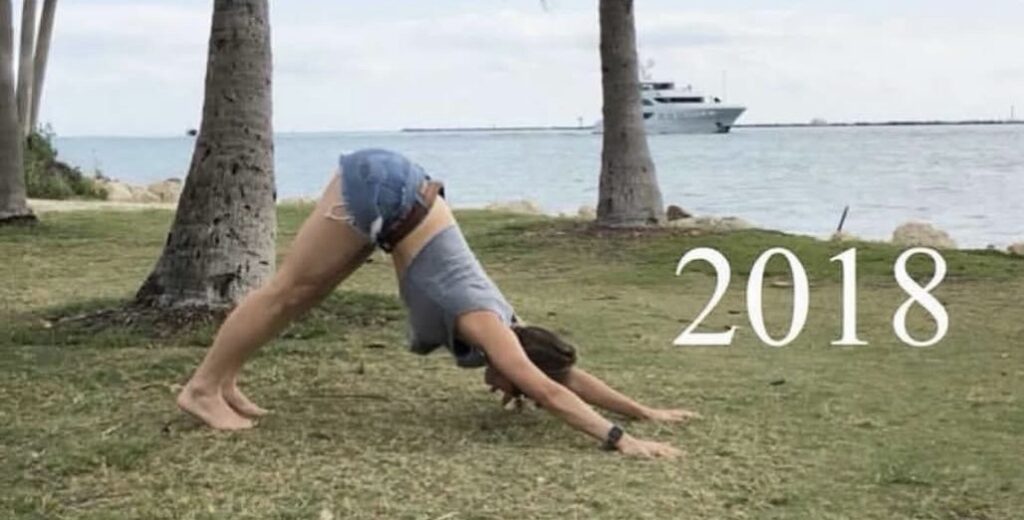
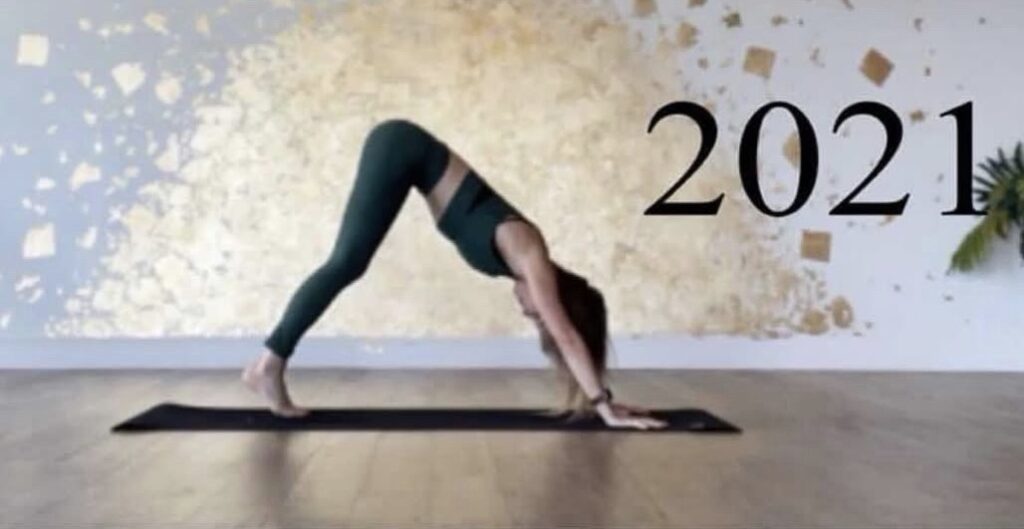
Many LYT Yoga teachers immediately understood the inquiry and recognized how the “before” photo appeared to reflect a more traditional approach (sinking the chest and shoulders toward the floor), while the “after” photo displayed a strong center, engaged shoulders, and slightly bent knees to maintain greater spinal alignment.
Others who responded were less certain about the differences but seemed to sense the noticeable shift of contained energy. And finally, a few people didn’t understand the idea of integration and/or defended the initial shape as being more representative of a “yoga pose.” Some went on to say, “It’s all yoga. Poses can look different for different people or purposes.”
And I agree.
Poses can look different. Bodies are different. And there is no single shape that every body needs to make. But this is exactly why I think it is important to examine poses. Because a pose is not simply a shape, but also an expression of energy.
What Downward Dog Alignment Can Reveal
When we look at a photograph of someone in Down Dog, we are seeing the end result of countless decisions, conscious or unconscious, about where the body is organizing, where it is collapsing, where it is generating force, and where it is allowing force to dissipate. The body is always communicating signals through movement.
In the first photo, the student is creating a familiar Down Dog shape, but much of her organization is moving downward. The chest collapses toward the floor, the shoulders drift toward the ears, and the spine follows that collapse. The energy depicted reveals a decreased sense of the body pushing into the ground and using that contact to create a response through the rest of the system.
In the second photo, the shape is actually less “perfect” by some conventional standards because the knees are slightly bent and the chest isn’t being forced toward the floor. But something important has changed, making it far more functional; she is organized around her center.
The hands are actively connecting with the floor, the shoulders are integrated with the spine rather than hanging off it, the spine has more continuity, and the knees are allowed to bend so that the pelvis and spine can remain better organized. The shape may look less dramatic, but the body looks more available. There is a sense of energy moving through her rather than energy leaking out of her, and that distinction matters.
A Pose Is More Than a Shape
One of the things I find fascinating about yoga is that we can become so focused on what a pose looks like that we lose sight of what the body is actually doing. We can chase the straightest legs, the deepest fold, the lowest chest, the biggest range of motion, but greater range doesn’t necessarily mean greater integration.
A body can make an impressive shape while simultaneously losing its center, its connection, its ability to generate force, or its ability to adapt. Conversely, a body can make a seemingly modest shape and be incredibly organized, strong, responsive, and integrated.
This is why I don’t teach poses as destinations; I teach them as opportunities to investigate movement.
- What is your body doing to create this shape?
- Where is the force coming from?
- Where is it going?
- What is connected?
- What is collapsing?
- What is supporting what?
- Can you breathe?
- Can you move from this position?
- Can you create more force without losing organization?
These questions take us beyond aesthetics and into movement intelligence.
Integration Is Not Conformity
When I use the word integration, I am not suggesting that there is one ideal Down Dog. Integration doesn’t mean conformity; it means that the parts of the body are communicating and contributing to a larger whole.
The shoulders don’t have to look a certain way. The knees don’t have to be straight. The heels don’t have to touch the floor. The spine doesn’t have to fit a predetermined visual template.
Instead, we want to ask: Is this person’s current strategy allowing the body to work as a coordinated system?
That answer will be different from person to person, and it may even be different for the same person depending on the intention of the movement.
That freedom of choice in the moment is an important distinction. Because saying “poses can look different” is true, but it doesn’t mean that every strategy is equally effective for every purpose. If our intention is to create strength, stability, mobility, balance, or the ability to transfer force, then how we organize the body matters.
Even though I have the flexibility to have straight legs and heels down in Down Dog, I choose to keep my knees bent most of the time because it feels more integrated through the core and more supportive of the pelvis. This choice gives me more freedom when lifting one leg and moving through transitions.
This is why I believe examining poses is so valuable: a pose gives us a snapshot. But movement gives us the story.
And when we learn to look beyond the shape, to see the relationship between the ground, the center, the spine, the limbs, the breath, and the nervous system, we begin to see something much more interesting than whether a pose is “right” or “wrong.” We begin to see how a human being is organizing energy.
Why Movement Quality Matters Beyond the Pose
We live in a culture that often rewards the appearance of movement rather than the quality of movement. We celebrate how far someone can go, how deep they can get, how straight their legs are, or how closely they can reproduce a particular shape.
But real-life movement doesn’t happen in frozen shapes.
We walk, run, lift, carry, reach, rotate, climb, fall, recover, play, and respond to an unpredictable environment. Therefore, we need bodies that can adapt, not simply bodies that can reproduce positions.
I want to practice and teach through this lens of inquiry, rather than making a shape simply to look like a picture. The question I was asking through the before-and-after photo is one that I ask myself in my own practice:
How can I become more integrated, more responsive, and more powerful within my own body?
Because ultimately, the goal isn’t the pose; the pose is simply one expression of the way we move through the world.
Explore the LYT Method and learn how functional movement, smart alignment, and core integration come together in practice.